By Mark Atkinson
Photos courtesy Toyota Canada
The immensely popular Toyota Echo hatchback will be ‘replaced’ in 2006 by the new slightly larger ‘Yaris’ model. Well, not exactly replaced as the Echo hatch has always been known as the Yaris in Europe (and the Vitz in Japan, but that’s just getting confusing…)
At any rate, the new Yaris will offer much of the same: reasonable price, great fuel economy, decent performance, Toyota reliability and rock-solid resale values. The Yaris will continue to be offered in both 3-door and 5-door configurations with two or three trim levels for each. The top-of-the-line RS will feature slight cosmetic tweaks and larger wheels and tires, but no increase in performance over the standard 106 hp.
While the Yaris was recently previewed at the 2005 Frankfurt Auto Show a few days ago, Toyota Canada will give Canadians their first look at the 2006 Yaris when the hatchback goes on display September 16 at the Georgian College Auto Show. Visitors are invited to the Toyota area during show hours running from September 16-18 in Barrie, ON.
Wednesday, September 14, 2005
NEWS: 2006 Toyota Yaris Announced


NEWS: 2006 Lexus SC 430 Redesigned
By Mark Atkinson
With files and photos from Lexus Canada
For 2006, Lexus has made a series of changes to its SC 430 convertible coupe. While never the a class-leader in performance terms, the two-door has always served as a competent cruiser. So refinements to the front and rear views make it better looking, and a new 6-speed automatic transmission helps keep the performance in line with its more traditional competitors.
In line with the new Lexus L-Finesse design philosophy, the headlamps, grille, bumpers and rear combination lamps are redesigned to further enhance the premium feel of the luxury sports coupe. New 18-inch aluminum alloy wheels firmly connect the SC 430 to the road, while an Adaptive Front lighting System (AFS) now equips the vehicle for better illumination in turns.
The rear-wheel-drive SC 430 is powered by a carryover 4.3-litre, 32-valve aluminum alloy DOHC V8 engine that produces 288 horsepower at 5,600 rpm and 317 lb/ft of torque at 3,400 rpm. This powerplant not only moves the 1,742-kilogram SC 430 from 0-60 mph in a swift 5.9 seconds, it is tuned to provide consistent torque across a substantial range of engine speeds for immediate and dependable response.
Equipped with Lexus’ most effective emissions and fuel economy controls, including sophisticated VVT-i (Variable Valve Timing-intelligent) technology that continuously optimizes tuning characteristics based on engine speed and load, SC 430 is certified as an Ultra Low Emissions Vehicle (ULEV).
The SC 430’s transmission is a new 6-speed automatic Super ECT (Electronically Controlled Transmission) that manages shift decisions based on engine speed and load. It also monitors throttle position, road speed, power requirements and operating temperature to efficiently direct gear selection and even adjusts for the slight wear on parts over time so shifts remain crisp.
Torque Activated Powertrain Control continuously analyzes accelerator pedal angle, engine operating conditions and vehicle speed, then adjusts the throttle to maintain even velocity. The system automatically holds shifts for hill climbing and downshifts automatically when the brake pedal is engaged so that, with only small adjustments in pedal pressure, adequate torque is always available and unnecessary downshifts are avoided.
Back by popular demand is the Pebble Beach Special Edition, with its dramatic colouring and exclusive trim. For 2006, a Tigereye Mica exterior is complemented by a camel interior and espresso dark brown wood. Each Pebble Beach model comes with a leather luggage set, along with unique badges and floor mats.
The 2006 Lexus SC 430 is priced at $92,650, and the Pebble Beach edition has a Manufacturer’s Suggested Retail Price of $93,850.


NEWS: 2006 Toyota 4Runner Updated
With files and photos from Toyota Canada
With a choice of potent V6 and V8 engines, and an extensive array of stability and traction management technologies, the 2006 Toyota 4Runner combines outstanding off-road capability with on-road comfort and all-weather safety.
For the 2006 model year, 4Runner is enhanced with:
• revised headlamps, bumpers, LED rear combination lamps, grille, fog lamps and fender flares.
• 4Runner Limited V6 and V8 models get 18-inch alloy wheels, and a memory function on the driver’s seat and side mirrors.
• 16-inch alloy wheels are now standard on the 4Runner SR5 V8.
• A Sport Package for the 4Runner SR5 V6 and V8 now includes power seats and in-dash 6- CD changer.
• All sound systems now include a mini-plug and MP3 player.
Manufacturer’s Suggested Retail Price (MSRP) for the revised 2006 4Runner SR5 V6 starts at $39,960, while the Limited V6 has an MSRP of $49,950. The V8-equipped 4Runner SR5 has an MSRP that starts at $42,840, while the Limited V8 has an MSRP of $52,585.


NEWS: Hyundai Opens New Environmental Technology R&D Centre
With files from Hyundai Canada
Hyundai Automotive Group today held the grand opening of the new Environmental Technology R&D Centre. As the new home of Hyundai’s environmental research efforts, the Centre will spark new synergies and generate greater efficiency in Hyundai’s efforts to develop cleaner, more eco-friendly vehicles.
Located on the southern edge of Seoul in Mabuk, phase 1 of the centre was completed with a total investment of US $58 million after start of construction in July 2003. The scale of the investment is a clear sign of the Hyundai Motor Company’s commitment to attain global leadership in environmental management.
Situated on a 30,488-sq. meter site, the five-story 14,233 sq. meter facility is home to 200 researchers and more than 400 pieces of high-tech equipment. Facilities include a 700-bar hydrogen filling station, a fuel-cell endurance tester, an emissions lab, dynamometers and other specialized equipment for testing electric propulsion systems. A pilot plant for automated vehicle dismantling focuses on improving the material recycling rate of end-of-life vehicles.
The new centre will allow Hyundai to proactively respond to the intensifying environmental regulations in the areas of product development, manufacturing, sales, after service, and vehicle recycling.
Of particular note, the 700-bar hydrogen filling station, coupled with the 350-bar station at the Group’s Namyang R&D Centre will enable fuel-cell vehicle tests within the Seoul metropolitan area and will help accelerate the commercialization of fuel-cell electric vehicles.
Furthermore, in line with the purpose it seeks to serve, the centre itself was contracted using environment-friendly materials and processes such as vacuum toilet systems which in using one-tenth the water of a conventional flush toilet results in 1,500 tons of water savings annually; heating and air conditioning systems using heat pumps; natural light systems using solar reflectors; floors made of scrapped tires; and electric power created from actual fuel-cell tests used during technology development that will result in a 1,000-ton reduction in CO2 emissions
NEWS: 2006 Honda Civic Revealed
By Mark Atkinson
With files from Honda Canada
Honda has officially revealed the details on its eighth-generation Civic, which has been one of the most popular cars in Canada for decades. While we’ll wait for a full test to completely go through the myriad details of the brand-new car, here are some of the highlights you can look forward to for the 2006 model.
There will be two bodystyles sold in Canada, the sedan and coupe, with various trim levels of each. The Civic Si Coupe returns to its full glory, something that unfortunately couldn’t be said for its now-retired hatchback cousin. Expect close to Acura RSX Type-S levels of performance thanks to an i-VTEC equipped 2.0-liter, 197-horsepower version of Honda’s venerable K-series engine combined with a six-speed manual transmission.
On the other side of the scale, the Civic Hybrid features a 1.3-liter four-cylinder with IMA (Integrated Motor Assist), that combined with the standard CVT, provides an estimated highway fuel economy of 4.3 L/100km.
The Civic Si will only be offered in the coupe body, while the Hybrid remains a sedan.
The ‘bread-and-butter’ Civic sedans and coupes will feature a brand-new 1.8-litre i-VTEC SOHC 4-cylinder engine that produces 140 horsepower (10 to 21 percent increase, depending on trim level) and 128 lb-ft. of torque (12 to 16 percent increase, depending on trim level).
Honda has a tradition of making its vehicles fun-to-drive with responsive suspension tuning and refined road manners. The 2006 Honda Civic chassis features refined suspension geometry with larger wheels and tires, a longer wheelbase, and a new-generation 4-channel anti-lock braking system.
The all-new MacPherson strut front suspension design incorporates new geometry with a high caster angle for straight line stability along with improved toe-control dynamics for sharp and responsive steering. Honda claims that changes to steering angles, bushings, material rigidity, and spring and shock tuning result in amazingly linear suspension movement at the upper limit of vehicle dynamics.
The majority of 2006 Civics will be produced and assembled using domestic and globally sourced parts in Canada and the U.S. The Civic Coupe and Civic Si models – and in fact all Civic 2-door coupes built for the global market – will be produced and assembled exclusively at the Honda of Canada Manufacturing (HCM) plant in Alliston, ON.
Civic Sedan models will be primarily produced at the Honda of America Manufacturing plant in East Liberty, OH, although the majority of Civic Sedans for the Canadian market will be built at the HCM plant in Ontario. All Civic Hybrid models are built in the Honda Motor Co., Ltd., Suzuka, Japan, manufacturing facility.
We’re certainly eager to get our hands on all of these all-new models, so check back throughout the fall for more involved driving impressions.


DRIVEN: 2005 Dodge Viper SRT10
Story by Mark Atkinson
Photos by Mark Atkinson and Michael Banovsky
The Dodge Viper, in all its iterations over the last 16 years – RT/10, GTS, ACR, SRT10 – has garnered a mixed reputation by automotive journalists and enthusiasts alike thanks to the combination of massive power and ‘right now’ handling with very little else to show for it.
Since its introduction, the Viper has been at the top of the North American performance car pile; the last generation Corvette Z06 came the closest, but wasn’t quite powerful or brutal enough to knock it off its perch, while any version of the Ford Mustang – supercharged or not – was just too far away to begin with to offer any real competition.
The only real ‘homegrown’ talent to take away the crown of American Bad-Ass is the new Ford GT, which easily mixes it up with the Ferraris and Lamborghinis of this world, but hasn’t been available in Canada to this point.
So that leaves the Viper SRT10 in a curious position as the not-quite-at-the-top-but-still-somewhat-reasonably-priced-two-seat-blow-your-doors-off-sportscar, which it holds quite admirably.
While the Viper SRT10 was completely overhauled for the 2003 model year, the new look still surprises, mainly because there seem to be so few of them out there. The design certainly retained many of the original’s styling cues, however the new look really does away with the original’s dramatic curves and bulging fenders. Spend enough time poring over the second generation, and you’ll discover it really does look sharp.
The Viper badge has been updated, while the cross-hair front fascia remains. The rear lights mimic the earlier generation’s, and the rear bumper sports a working diffuser.
But really – let’s be honest here. The body panels, chassis and everything else are simply built around the SRT10’s engine, which we all know is an 8.3-litre all-aluminum, pushrod V10 that unleashes a monstrous 500 hp @ 5600 rpm and 525 lb-ft @ 4200 rpm. All that motivating force is controlled by a six-speed manual transmission geared high enough for the SRT10 to top 300 km/h, and a Dana Hydra-Lok speed-sensing limited-slip differential to try and keep the 3,410 lb two-seater pointed roughly in the correct direction.
Open the hood – conventionally this time; Dodge did away with the heavy, expensive one-piece clamshell piece from the first gen – and you’ll see those crinkle-red valve covers topping the relatively compact unit. It’s mounted very far back in the chassis to aid in weight distribution, and is thankfully not obscured by gigantic plastic shrouds, something which is de rigueur nowadays.
While the original RT/10’s side-pipes were said to produce sounds like an angry UPS truck, the SRT10’s have been tuned much more aggressively, and with even part throttle, the V10 just roars. Tunnels will soon be your friends.
Nevertheless, once you’re underway, the Viper’s reputation of biting inattentive – or just plain dumb – drivers hard is easy to understand. With so much power, a heavy shift action, and those wide front tires tram-lining all over the place, the SRT10 is certainly a ‘two-hand’ vehicle. A latte-sipping road couch it isn’t.
While those fancy computer-controlled paddle-activated sequential-shifting transmissions are usually a complete waste of time, the Viper would probably be the best candidate out there to have one offered, simply because you wouldn’t have to risk moving your arm from the steering wheel to the shifter and back again. But the added weight and complexity would completely go against the car’s ethos, so don’t count on that happening anytime soon.
Speaking of that ethos, the Viper is refreshingly free of any and all forms of traction and stability control – other than the 100-year-old ‘analog’ method of using your brain. Dodge does claim that they’ve fitted ABS, but four-piston calipers squeezing 335mm vented discs combined with the ultra-sticky 275/35 ZR-18 Michelin ZP tires (345/30 ZR19 out back) meant that they didn’t activate once in the four days I had with the SRT10.
To be honest, most of the time I drove like a grandmother, breathing gently on the throttle, shifting up early, cruising at 110 km/h with the engine lugging a tick over 1100 rpm. Two days were spent almost exclusively with the top up and the air conditioning on while touring the Niagara wine region – surprisingly, the SRT10 proved to be a decent touring companion. Never complaining or overheating, despite the near 40C days with rainforest levels of humidity, and the seats were perfectly shaped for long-distance travels.
But when those times arose when I did push the ‘go’ pedal further, the Viper was a willing companion. Too willing, in fact. There is absolutely no public place where you can morally push the SRT10 to its limits. And if you do, then suffer the consequences – you’ll get no pity from me.
While that may sound harsh, Dodge has gone and built just about the ultimate sports car; it features nothing more than it absolutely needs, including all those creature comforts that you can now find on sub-$20K economy sedans.
The car’s biggest departure comes in the form of its roof. It is a conventional convertible with a manual fabric top rather than the older one’s targa-style afterthought. While it’s not a complex system, the major gripe comes from needing to have the trunk open to raise or lower the top, which means lots of gymnastics getting in and out over the wide (and usually roasting hot) sill to go al fresco. Once either fitted or stored, the roof is clean and unobtrusive; it’s the transition that grates.
As a competition vehicle, the Viper would probably be overwhelmed by a typical Solo 2 event – it’s too wide and fairly unsuited to the domain of tiny and nimble Miatas and Civics. Something that allows it to stretch its legs would be more appropriate. For those really serious about getting a Viper race car, Dodge does offer a Competition Coupe version, which really is a factory-made ground-up racing version, one of which you can see regularly competing in the CASC-OR Ontario Challenge Cup, not to mention the hordes on the grid at every SPEED World Challenge GT event.
At any rate, there will certainly be two types of Viper SRT10 buyers: those who find it to be the best combination of power, balance and brutality at half the price of its competition, and those who simply want to spend $127,000 to pose and look good driving down Yonge Street.
Either way, it’ll make you a hit at parties; one ‘gentleman’ who I let sit in the driver’s seat nearly offered me his first-born in thanks and couldn’t stop mentioning that it had been the greatest moment of his life. While I suspect a heavy dose of alcohol was involved, it certainly helps prove just how many fanatics there are for whom the Viper will always be the ultimate in anti-PC sports cars.


DRIVEN: 2006 Volvo XC90 V8
Story by Michael Banvosky
Photos by Michael Banovsky and Volvo Canada
Can something be clean burning, yet inefficient? Safe but insecure? Useful and useless?
Consider the 2006 XC90 V8, equipped with Volvo’s first V8. As their taglines say: “Perhaps it’s the best V8 on the planet, because it’s the best V8 for the planet.”
The new, Yamaha-developed, ultra-compact all-aluminum 4.4L V8 produces 311 horsepower at 5850rpm, and a maximum of 325lb.-ft of torque at 3900rpm. Mated to a new six-speed automatic transmission and Volvo’s Haldex electronically-controlled all-wheel-drive system, the 0-100km/h sprint takes a mere 6.9 seconds.
Despite the performance, the engine meets both the American ULEV II and the European Euro 5 exhaust emission regulations. The question is: with an engine that drinks 16.4 L/100km in the city and 10.7 L/100km on the highway - 17 and 26 mpg respectively - is it more important to have low fuel consumption or good emissions? If those figures seem high, they are. Even with effort (and after the first 80L tank drained in under two days), I couldn’t manage better than 14 L/100km on the highway and 17L/100km in the city - closer to 19 mpg combined.
They’ve mated the engine to a large, over-two-metric-tonne SUV that features inflatable side curtain airbags for all three rows of seats, whiplash-reducing front seats, side-impact airbags for the first two rows of seats, and dual-stage front airbags. For electronic acronyms, the XC90 V8 has DSTC (Dynamic Stability and Traction Control) and RSC (Roll Stability Control). Basically - and I tried under controlled conditions - the computers will cut in at even a hint of a rollover. Impressive, but why fit tons of security systems to an inherently unstable vehicle type?
Finally, as of this writing the XC90 is rated to tow 5000lbs. If that looks familiar, it’s the same amount that an XC90 T6 will tow - but most owners will never take it off-road. For the record, the XC90 is also one of the few relatively capable road-biased SUVs. In other words, it will almost never be used to its full potential.
But, as I’ve discovered, this isn’t a logical Volvo. The Swedes have tried to over-think the SUV, and come up with a truck full of contradictions instead.
Which is why I like it.
Flooring the gas pedal unleashes a sonorous roar that is more refined than the sound from an American V8, but contains more character than is found in a typical Japanese lump. The handling up ‘till the limit is controlled and precise. As a bonus, the interior controls, the look of the ‘ute, and the cargo space are just plain sweet.
For an as-tested price slightly north of $71,000, it’s a big emotional leap. On paper, the XC90 V8 seems like an overpriced BMW X5 alternative. On the road; however, it might be worth it.
Finally, a Volvo that makes no sense.


Friday, August 19, 2005
NEWS: Dodge Announces Charger SRT8 Pricing
Special to Inside Track
Photo Courtesy DaimlerChrysler Canada
WINDSOR, ON – August 18, 2005 – DaimlerChrysler Canada announced pricing for the quickest sedan in its lineup, the all-new 2006 Dodge Charger SRT8.
Adding a new level of Dodge DNA to the SRT (Street and Racing Technology) formula of benchmark performance at the lowest price, the all-new 2006 Dodge Charger SRT8 is available for $44,650. Dodge Charger SRT8 arrives in dealer showrooms in November.
The all-new 2006 Dodge Charger SRT8 is powered by a 6.1-litre HEMI V-8 engine producing 425 horsepower and 420 lb.-ft. of torque, and is equipped with a host of performance upgrades and premium amenities.
Wednesday, August 17, 2005
NEWS: All the latest...
By Michael Banovsky
Photos courtesy their respective manufacturers
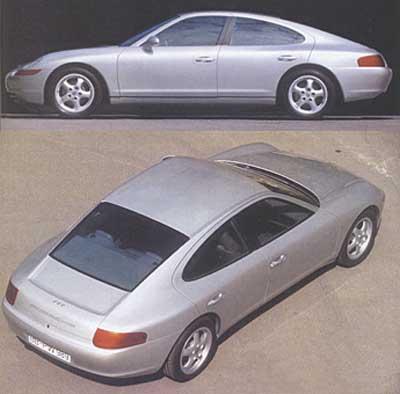 According to Autoweek.com, the long-rumoured, super-secret Porsche 4 door that was never photographed and subsequently crushed well...photographed and not crushed. This photo depicts an early 90s 911, with all of the current 911 styling cues intact. Draw your own conclusions as to why the photo was released...
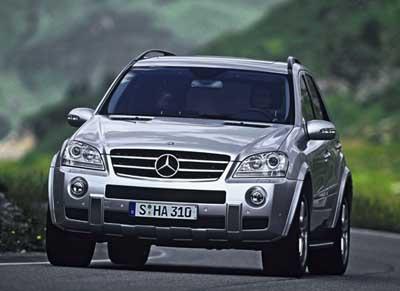
Mercedes-Benz ML63 AMG
I wonder: Will this hot ML sell like the old one? If so, only a few fat cats in North America will find homes for the successor to the old AMG Hammer sedan. In other words, a really fast SUV is still quite mental. Best quote from the press release:"
As in a Formula 1 racing car, the seven gears can be changed using the gearshift buttons on the AMG ergonomic sports steering wheel."
From Mercedes-Benz: "The powerful heart of a high-performance athlete beats beneath the bonnet of the ML 63 AMG: as a completely new and autonomous development by Mercedes-AMG, the AMG 6.3-litre V8-engine generates an output of 375 kW/510 hp at 6800 rpm and a maximum torque of 630 Newton metres at 5200 rpm; this makes the new AMG powerpack the world’s most powerful naturally aspirated eight-cylinder engine in regular production.
 This unique combination of a high engine speed concept and a large displacement enables the best of both worlds to be achieved: outstanding liveliness accompanied by powerful torque from low engine speeds. The driver of the ML 63 AMG experiences the decidedly sporty character of the new AMG V8-engine in the form of great agility and dynamic responsiveness in all engine speed ranges.
No other off-roader in the direct competitive lineup has a larger displacement and output than the new ML 63 AMG. The AMG 6.3-litre V8-engine provides the performance levels of a sports car, with acceleration from zero to 100 km/h in just 5.0 seconds and a maximum speed of 250 km/h (electronically limited). Compared to the preceding ML 55 AMG with 255 kW/347 hp and 510 Newton metres, the new ML 63 AMG generates 46 percent more output and 23 percent more torque.
Power transfer in the top M-Class model is via an AMG SPEEDSHIFT 7G-TRONIC automatic transmission with a DIRECT SELECT shift lever mounted by the steering wheel. Three shift modes specially configured for the sporty performance characteristics of the AMG V8-engine ensure that the power is used to best effect. These shift modes - "S" (Sport), "C" (Comfort) and "M" (Manual) – are selected using a switch in the centre console and differ in their gearshift characteristics and speed.
 As in a Formula 1 racing car, the seven gears can be changed using the gearshift buttons on the AMG ergonomic sports steering wheel. The permanent four-wheel drive of the ML 63 AMG is also decidedly sporty in nature: in the interests of the best possible agility and performance on bends, the generous power of the AMG V8-engine is distributed to the front and rear axles on a 40:60 basis. A specially strengthened drive train ensures an optimal power transfer and the reliability typical of a Mercedes."
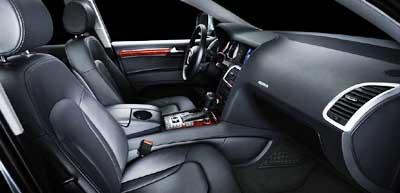
Audi Q7
 After teasing us for about six months, Audi has finally released photos of their new SUV, the Q7. Deliveries start in the new year. Engines are their FSI 4.2L V8 and, well...saints be praised:
No, not do-it-yourself jobbies, but an article on the origin of several well-known badges. The article can be found at: Business Week.
Click at your own risk.
Thursday, August 11, 2005
NEWS: Mitsubishi Sportback
By Michael Banovsky
Photo courtesy Mitsubishi
Here it is, folks: The new Lancer Evo X. Okay...it's what Mitsubishi are showing at the Frankfurt show in September. Still, it's a good indication of how the Lancer/Lancer Evo will look when sitting on DaimlerChrysler's new small-car platform.
Let the turbo kits begin.

